
Share :


Finding the “sweet spot” for pricing is often the most challenging part of running a successful jewelry boutique. Price your items too high, and they sit in the display case gathering dust; price them too low, and you’re essentially working for free. For retailers specializing in 925 sterling silver, the goal is to balance perceived luxury with accessible value.
Whether you are a seasoned shop owner or a new entrepreneur sourcing from a silver jewelry factory in Bangkok, mastering the art of the markup is your fastest route to a sustainable, profitable business.
Before diving into the variables, it is helpful to understand the “industry standards” that many retailers use as a baseline.
Keystone Pricing (2x): This is the traditional gold standard. You simply double the wholesale cost. If you bought a ring for $15, you sell it for $30.
Triple Keystone (3x): Common in high-end boutiques or galleries where overhead is high. A $15 ring becomes a $45 ring.
MSRP (Manufacturer’s Suggested Retail Price): Many suppliers provide a suggested price. While helpful, it doesn’t always account for your specific local market or operating costs.
Value-Based Pricing: This moves away from the “cost + percentage” model and looks at what the customer is willing to pay. A unique, artisan-style piece might command a 4x or 5x markup because of its “wow factor.”
A markup isn’t just about profit; it’s a safety net for your expenses. When you look at thailand wholesale jewelry options, your landed cost is only the beginning. Here is what should influence your final price tag:
1. Overhead and Operational Costs
Every time a customer walks through your door or clicks on your website, it costs you money. You must factor in:
Rent and Utilities: Physical storefronts require a higher markup than online-only shops.
Staffing: Expert sales associates who can explain the quality of 925 silver add value but also cost.
Packaging: High-quality boxes, polishing cloths, and branded bags enhance the unboxing experience but eat into margins.
2. Marketing and Customer Acquisition
In the digital age, “build it and they will come” is a myth. Whether you are running Instagram ads or hosting local trunk shows, your pricing must cover the cost of finding your next customer.
3. Shipping, Duties, and Taxes
When importing from a silver jewelry factory in Bangkok, remember to calculate the “landed cost.” This includes the wholesale price plus international shipping, insurance, and any import duties specific to your country.
4. Inventory Turnover and Risk
Fine jewelry doesn’t expire, but trends do. If you are stocking high-fashion pieces that might be “out” next season, you may need a higher initial markup to offset future clearance sales. Conversely, timeless staples like those found in the Planet Silver shop offer more stability.
To build a truly resilient pricing strategy, you need to look closer at the hidden costs:
The “Luxury” Tax on Time: How long does it take to photograph, list, and describe a piece? If you spend two hours marketing a $10 earring, your labor cost is likely higher than the profit.
Return Rates: Jewelry is a high-touch item. Factoring in a small “return buffer” (usually 1-3%) into your markup ensures that a few returns don’t tank your monthly profit.
Credit Card Fees: Most processors take 2.9% + $0.30 per transaction. It seems small, but on a $1,000 month, that’s $30+ out of your pocket.
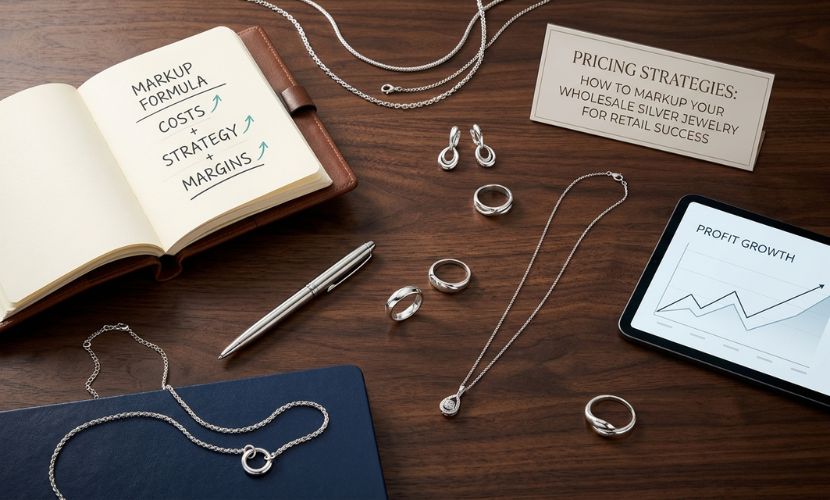
If you are looking for a concrete formula to apply to your next order of thailand wholesale jewelry, try this weighted approach:
Retail Price = [ (Wholesale Cost + Landed Expenses) x Markup Multiplier ]+ Fixed Overhead Buffer
The 3-Step Strategy:
1. Categorize Your Inventory:
-Core Basics: (Chains, plain bands, studs) – Use a 2x to 2.5x markup. These are your “volume” items.
-Trend/Seasonal: (Bold earrings, statement necklaces) – Use a 3x markup to cover the risk of style shifts.
-Boutique/Exclusive: (Unique designs, intricate stone work) – Use a 3.5x to 4x markup based on perceived value.
2. Research the Competition: Look at what similar boutiques are charging. You don’t have to be the cheapest—in jewelry, being the cheapest can sometimes signal “low quality” to a buyer—but you should be in the same ballpark.
3. Test and Adjust: If a specific collection sells out in 48 hours, your markup might be too low. If it hasn’t moved in three months, consider a promotional “bundle” rather than a permanent price drop.
Your retail success is inextricably linked to your wholesale partner. To maintain a healthy silver jewelry markup, you need a supplier that offers a balance of competitive factory pricing and impeccable quality.
At Planet Silver, we understand that our success depends entirely on your success. By operating as a direct silver jewelry factory in Bangkok, we eliminate the middleman, allowing you to secure premium 925 sterling silver at prices that leave plenty of room for your retail margins.
Choosing a reliable partner isn’t just about the invoice price; it’s about consistency. When you know every piece will arrive polished and meeting international standards, you spend less time on quality control and more time on sales. You can read how other retailers have scaled their businesses in our testimonials section.
Pricing is as much about psychology as it is about math. If you are confident in the quality of your silver—knowing it was ethically and expertly crafted—you will have no trouble justifying your markup to your customers.
Ready to restock with high-margin, high-quality pieces? Explore our wholesale information to see how we can help you hit your profit goals this year.