
Share :


Running a successful jewelry retail business means constantly balancing two massive challenges: keeping up with consumer trends and managing your upfront costs. Whether you run an independent boutique, a growing e-commerce brand, or a high-volume retail chain, your sourcing strategy dictates your long-term survival.
When looking to expand your collection of premium sterling silver jewelry, you will inevitably face a critical fork in the road: should you go with white label manufacturing or private label production? While many business owners use these terms interchangeably, they represent two completely different operational models. Choosing the wrong one can lock up your cash flow or leave you exposed to aggressive competition.
Let’s lift the curtain on white label vs private label jewelry so you can confidently pick the path that maximizes your profit margins and delights your customers.
At its core, white label jewelry involves purchasing pre-made, unbranded designs directly from a manufacturer’s existing catalog. The factory mass-produces these generic items and sells the exact same styles to multiple retailers simultaneously.
As a retailer, your job is simple: you select the pieces that match your aesthetic, apply your custom packaging, hangtags, or velvet pouches, and market them under your own brand name. You are not creating a new design from scratch; instead, you are curating a collection.
The Pros for Retailers:
Rapid Time-to-Market: Because the designs already exist and the tooling is complete, you can launch a new collection in as little as two to three weeks.
Minimal Financial Risk: White labeling comes with incredibly low startup costs and accessible minimum order quantities (MOQs), allowing you to test market demand safely.
Proven Sellers: You are buying designs that the manufacturer knows sell well, reducing the risk of ending up with dead stock.
The Cons for Retailers:
Zero Exclusivity: Because the manufacturer sells to anyone, your direct competitors could easily offer the exact same silver jewelry pieces. Your differentiation relies entirely on your marketing, customer service, and brand storytelling.
Private label jewelry takes customization a step further. In this model, you partner with a manufacturer to produce jewelry exclusively for your brand based on your unique specifications.
This doesn’t necessarily mean you need to be a professional CAD designer drawing blueprints from scratch. It could mean taking an existing base design from a manufacturer and modifying it—altering the dimensions, choosing a specific thickness of gold plating over the sterling silver base, or adding a signature gemstone setting that belongs solely to your store. The defining feature here is exclusivity: the manufacturer signs an agreement promising never to sell your specific iteration to another retailer.
The Pros for Retailers:
True Brand Equity: You own a unique product line that cannot be found anywhere else, giving you a massive competitive advantage.
Higher Pricing Power: Exclusivity drives perceived luxury, allowing you to command premium retail price points and enjoy gross profit margins often scaling between 40% and 60%.
Total Quality Control: You dictate the exact material weights, tolerances, and finishes from day one.
The Cons for Retailers:
Higher Capital Investment: Tooling fees, master molds, and custom prototypes require significant upfront capital.
Longer Development Cycles: Going from concept to production samples and final delivery can take anywhere from two to five months.
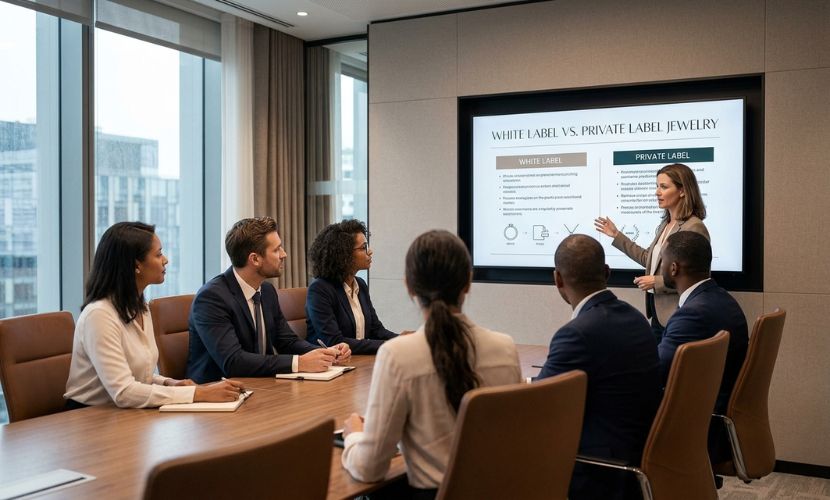
To help you clarify how these models impact your day-to-day operations, let’s map out the core differences side by side:
| Operational Feature | White Label Jewelry | Private Label Jewelry |
| Product Exclusivity | None; shared with other retailers | Complete; exclusive to your brand |
| Design Control | Limited to packaging and labeling | High; structural and cosmetic changes |
| Upfront Investment | Low; ideal for testing cash flow | Moderate to High; mold and CAD fees |
| Speed to Market | Ultra-fast (2 to 4 weeks) | Slower (2 to 5 months) |
| Average Profit Margins | Predictable, baseline margins | Maximum margins due to premium pricing |
| Inventory Risk | Low; smaller batch ordering | Higher; due to larger factory MOQs |
Choosing between these two models isn’t about finding a single “better” option; it’s about alignment with your current business stage.
If you are a new store owner, testing a brand-new target demographic, or trying to rapidly capitalize on a sudden micro-trend (like celestial motifs or bold hoop earrings), white label is your best friend. It keeps your capital fluid and allows you to pivot your inventory without taking massive losses if a style falls flat.
If you already have a loyal, established customer base and want to insulate your business from competitors undercutting your prices, it’s time to invest in private label jewelry. By offering proprietary silver jewelry designs, you build a defensible asset that keeps customers coming back to your storefront exclusively.
Many of the most profitable global jewelry retailers don’t choose just one. They use a hybrid approach. They populate roughly 70% of their store with reliable, high-quality white-label essentials (like classic chains, studs, and standard stackable bands) to maintain consistent cash flow. Then, they reinvest those profits to fund a 30% signature line of private-label statement pieces that truly define their unique brand identity.
Regardless of the business path you choose, your retail success ultimately hinges on the reliability of your manufacturing partner. In the silver jewelry industry, consistency in metal purity, ethical sourcing, and flawless polishing are non-negotiable.
This is exactly where Planet Silver excels. As a trusted, established wholesale manufacturer specializing in premium 925 sterling silver jewelry, they bridge the gap for retailers worldwide.
Looking to launch immediately? You can dive straight into their curated collections and order directly from their comprehensive online shop to get your retail shelves stocked with proven, trending designs.
Ready to scale your business operations? Take a close look at their dedicated wholesale information page to see how their production capacities, flexible order structures, and strict quality control standards can back your brand’s growth.
Need peace of mind? Don’t just take our word for it—read through their verified global customer testimonials to see why major retail buyers rely on them season after season for their inventory needs.
Your sourcing strategy shouldn’t stall your progress. If you need speed, low risk, and effortless scaling, white labeling gets you in the game today. If you have the capital and a distinct visual story to tell, private labeling secures your market position for the long haul. Assess your current cash flow, pick your model, and start building your jewelry empire.