
Share :


As a jewelry retailer, you know that the modern consumer is highly informed. They do not just look at a shiny ring or a pair of sleek hoop earrings and buy on impulse. They ask questions: “Will this turn my skin green?” “Can I wear this in the shower?” “What is the difference between this gold-plated piece and gold vermeil?”
When your sales team can answer these questions with confidence, it changes the entire dynamic of your store. You shift from being a salesperson to a trusted advisor. Educating your customers removes the friction from their purchasing decisions, justifies your pricing tiers, and directly boosts your conversion rates.
To help you train your team and stock your inventory wisely, let’s break down the essential differences between Gold Plating, Gold Vermeil, and Sterling Silver, and explore how you can use this knowledge to drive more wholesale and retail sales.
925 sterling silver is a high-quality precious metal alloy consisting of exactly 92.5% pure silver and 7.5% other metals, typically copper. Because pure silver is naturally too soft to withstand daily wear, it must be alloyed with copper to provide structural strength and durability without sacrificing its signature brilliant shine.
The “925” hallmark stamped onto the metal serves as an official certification that the jewelry meets this exact, globally regulated ratio of purity.
– Exact Composition: 92.5% pure precious silver and 7.5% strengthening alloy (usually copper).
– The “925” Stamp: The universal hallmark indicating authentic, certified silver purity.
Why Retailers Love It:
It is a genuine precious metal that offers luxury appeal without the luxury price tag of solid gold. For stores looking to scale their inventory, sourcing high-quality wholesale 925 sterling silver provides an excellent margin-to-cost ratio. It is hypoallergenic for the vast majority of people and can last for generations if cared for properly.
Gold plating is a process where a thin layer of gold is chemically or electrochemically deposited onto the surface of a base metal. It gives jewelry the rich, warm aesthetic of solid gold at a fraction of the cost.
However, in the broader market, the quality of gold plating varies wildly. Many manufacturers use cheap base metals like brass, copper, or nickel, which can easily cause skin irritation or turn skin green once the thin gold layer wears down.
The Planet Silver Standard:
As a premium silver jewelry wholesale Thailand manufacturer, we do things differently at Planet Silver. We believe retail buyers deserve predictable quality.
Every single piece in our gold-plated jewelry collection uses authentic 925 sterling silver as the base metal—never cheap brass or random base alloys.
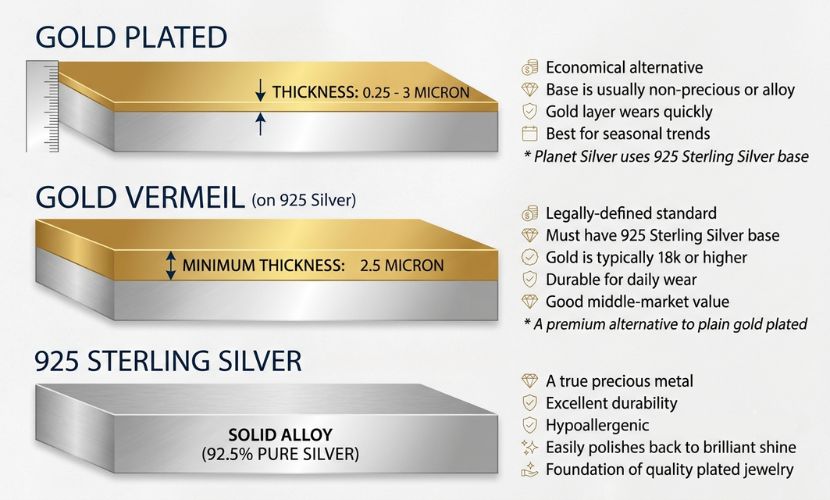
Furthermore, we offer professional gold plating thicknesses ranging from 0.25 to 3 microns (a micron is one-millionth of a meter). This allows you to choose the exact level of durability and price point that fits your target demographic.
Gold vermeil (pronounced ver-may) is a specific, legally regulated category of high-quality gold-plated jewelry. To be labeled as true gold vermeil in most international markets, a piece must meet three strict criteria:
The Base Metal: Must be authentic 925 sterling silver.
Gold Purity: The gold layer must be at least 10k or higher (typically 14k, 18k, or 24k).
Gold Thickness: The plating must be at least 2.5 microns thick.
How to Sell It:
Think of gold vermeil as the “bridge” between standard fashion jewelry and solid fine gold. Teach your customers that vermeil offers a significantly thicker gold layer than flash plating, making it highly resistant to daily wear and a fantastic investment piece for those who want long-lasting luxury.
When managing your inventory at the Planet Silver Shop, it helps to visualize how these materials compare across key performance and value metrics:
| Metric | 925 Sterling Silver | Standard Gold Plating | Gold Vermeil |
| Base Metal | Solid 925 Silver Alloy | Brass, Copper, or 925 Silver | Must be 925 Sterling Silver |
| Surface Metal | None (Solid Alloy) | Gold (10k – 24k) | Gold (10k – 24k) |
| Thickness | N/A | Typically 0.25 to 1.0 microns | Minimum 2.5 microns |
| Skin Sensitivity | Highly Hypoallergenic | Varies (Hypoallergenic if silver base) | Highly Hypoallergenic |
| Price Point | Moderate / Accessible | Budget-Friendly | Premium Demi-Fine |
To help your retail customers preserve the life of their jewelry, your team can pass down these simple, expert care strategies:
The “Last On, First Off” Rule: Tell your customers to always put their gold-plated and sterling silver pieces on after applying perfumes, lotions, or hairsprays. The chemicals in these products accelerate tarnish and degrade gold layers.
Storage Matters: Air and humidity are the primary enemies of silver. Recommend storing jewelry in airtight zip bags or soft cloth pouches when not in use.
Cleaning with Care: Never use harsh chemicals or abrasive polishing cloths on plated items. A gentle wipe with a soft microfiber cloth after a day of wear is all it takes to remove body oils and maintain that brilliant sparkle reflection.
Here are five common questions your retail shoppers will ask, complete with the ideal responses to help you close the sale.
Q1: How long will gold-plated or gold vermeil jewelry last?
The Retailer Answer: It depends largely on the thickness of the plating and how often it’s worn. Standard flash plating (0.25 microns) is great for seasonal, trendy pieces and can last several months of frequent wear. Higher-end plating (1 to 3 microns) and gold vermeil can easily last several years with proper care before showing signs of wear, especially since underneath the gold is solid 925 sterling silver.
Q2: Can I shower with my jewelry on?
The Retailer Answer: We strongly recommend taking it off before showering. While water itself won’t instantly destroy the piece, the soaps, shampoos, and chlorine in municipal water contain chemicals that can dull sterling silver and slowly wear down gold plating over time.
Q3: Will this jewelry turn my skin green?
The Retailer Answer: No, not when you buy quality. Skin turning green is caused by cheap base metals like copper or brass reacting with your skin’s natural acids. Because our gold-plated pieces utilize a high-quality 925 sterling silver base, they are nickel-free and highly skin-friendly.
Q4: What makes 925 sterling silver a good investment for everyday wear?
The Retailer Answer: Sterling silver is a precious metal, meaning it holds intrinsic value. If it tarnishes over time due to air exposure, it can always be polished back to its original brilliant shine. It doesn’t peel or wear away because the metal is solid the whole way through.
Q5: Why is there a price difference between gold-plated items that look identical?
The Retailer Answer: The value lies beneath the surface. A cheaper piece often uses a brass base and a microscopic layer of gold. A premium piece uses a precious 925 sterling silver base and a much thicker layer of gold (up to 3 microns). You are paying for longevity, skin safety, and true material value.