
Share :


As a jewelry retailer, few things damage customer trust faster than a piece of sterling silver tarnishing right on the display tray—or worse, just days after a customer takes it home. Silver naturally reacts with sulfur in the air, creating silver sulfide (tarnish).
Fortunately, modern jewelry manufacturing offers advanced surface treatments that preserve high-shine finishes. Applying a protective coating ensures your inventory stays brilliant, shelf-ready, and tarnish-free.
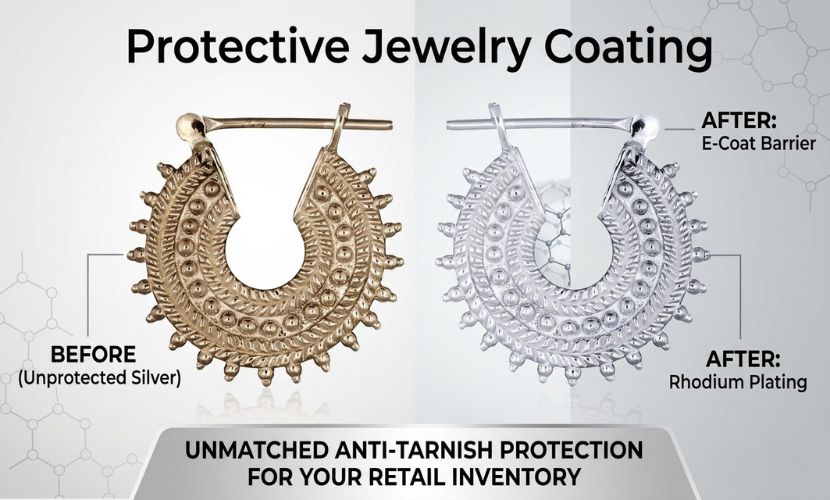
Two of the most popular protective finishes are E-Coat (Electrophoretic Coating) and Rhodium Plating. Understanding how these finishes work will help you choose the best options for your retail store, reduce returns, and boost customer satisfaction.
E-Coating (Electrophoretic Coating) is an industrial finishing process where an organic resin liquid is electrochemically applied onto metal surfaces.
Preparation: The silver piece is cleaned and degreased thoroughly to ensure complete adhesion.
Submersion & Charge: The jewelry is submerged in a liquid bath containing acrylic or polymer nano-resins. An electrical current is applied, attracting the resin particles evenly across the surface.
Curing: The piece is baked in an oven to cure and harden the liquid layer into a clear, durable barrier.
Invisible Protection: E-coat forms a microscopic layer that preserves the natural warm glow of standard silver without altering its color.
360-Degree Coverage: Because it uses an electrical bath, E-coat reaches recessed detail, tight intricate textures, and internal chain links that standard clear coats miss.
Hypoallergenic: It seals the metal, protecting skin sensitive to trace metals.
Cost-Effective: Offers premium tarnish resistance at an affordable price per unit.
Under normal wear, E-coating typically lasts from 1 to 3 years. Its lifespan depends on how frequently the item is worn and its exposure to chemicals, lotions, and friction.
E-coating shines on intricate sterling silver jewelry, plain silver bands, everyday earrings, and detailed pendants where retaining the original, rich silver shade is critical.
To prevent oxidation and tarnish, manufacturers use electroplating processes using metals like Silver, Gold, or Rhodium.
Yes. Because Rhodium and Silver share an almost identical cool-white luster, Rhodium Plating acts as a top-tier anti-tarnish layer and a highly effective replacement for standard silver plating. Rhodium is naturally non-reactive to sulfur, meaning it will never oxidize, tarnish, or turn black.
Extreme Tarnish Immunity: Completely shields the underlying silver from air, moisture, and sulfur exposure.
Superior Scratch Resistance: Rhodium is a precious metal from the platinum family known for its extreme hardness, making jewelry resistant to surface scuffs.
High-End Luster: Gives 925 sterling silver a brilliant, cool-toned finish often associated with white gold and platinum.
Hypoallergenic: Completely nickel-free barrier layer, making it suitable for sensitive skin.
| Feature | E-Coating | Rhodium Plating |
| Material Type | Organic Resin / Polymer Barrier | Precious Metal (Platinum Group) |
| Color Impact | Retains warm, original sterling silver tone | Adds a bright, mirror-like cool tone |
| Tarnish Resistance | High (Protective Barrier Layer) | Exceptional (Inherent Corrosion Resistance) |
| Scratch Resistance | Moderate | Very High |
| Price Point | Highly budget-friendly | Premium |
Choose E-Coating if you want to maintain low price points while providing reliable tarnish protection that preserves natural silver tones.
Choose Rhodium Plating for premium lines, gemstone settings, or high-touch rings where maximum durability, brilliant shine, and scratch protection justify a higher retail price.
At Planet Silver (planet925.com), we help retailers deliver long-lasting, tarnish-resistant silver jewelry directly to their customers. When placing your wholesale order, requesting your preferred protective finish is seamlessly integrated into our order flow.
Here is how simple it is to complete your purchase on our How to Order guide:
Register & Log In: Set up your account on our main page to access pricing and wholesale information.
Select Items: Explore our vast inventory in the Planet Silver online shop. Add items to your cart, or upload a custom SKU file using our Quick Order feature.
Specify Coating Preferences: Request anti-tarnish options like E-coating or Rhodium plating during cart selection or checkout instructions before finalizing your order request.
Order Confirmation: Our sales team will review your order details, apply any applicable discounts, and send a final invoice specifying your protective finishes prior to payment and shipment.
A protective coating is a specialized clear film (like E-coat polymer) or non-reactive precious metal layer (like Rhodium electroplating) applied over jewelry metals. Its primary function is to seal the metal off from sulfur, oxygen, and moisture, preventing oxidation, tarnish, and premature wear.
Retailers can prevent tarnish issues by sourcing pre-treated silver (E-coated or Rhodium-plated), storing stock in sealed, low-humidity environments with anti-tarnish strips, and advising retail buyers to keep jewelry away from harsh household chemicals, perfumes, and pools. For testing metal purity before coating, check our guide to spot fake silver.
Neither is universally “better”—it depends on your retail market. E-Coating is ideal for cost-conscious inventory because it offers great tarnish protection while preserving standard silver hues. Rhodium Plating is superior for premium collections due to its scratch resistance, bright platinum-like finish, and high-end feel.
Yes, all surface coatings gradually wear down over time due to skin friction, abrasion, and contact with chemicals. However, proper care extends their lifespan significantly—typically 1 to 3 years for E-coat, and even longer for Rhodium plating on items like earrings and pendants.
No. Neither coating adds noticeable weight to the piece. Furthermore, both E-coating and Rhodium plating act as nickel-free, hypoallergenic barriers, making your sterling silver collections safer for sensitive skin.